


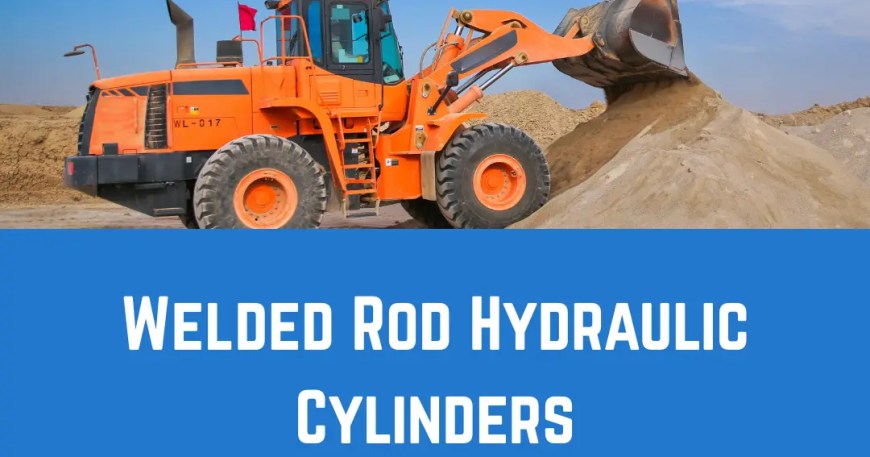

Welded rod hydraulic cylinders are a backbone of modern heavy equipment. Known for their strength, compact design, and durability, these cylinders are essential across construction, agriculture, snow removal, forestry, and industrial material handling. In this guide, you’ll learn how welded rod cylinders work, what sets them apart from other designs, and why OEMs and maintenance teams depend on them to keep critical machinery moving.
A Guide to Welded Rod Hydraulic Cylinders
What Are Welded Rod Hydraulic Cylinders?
Welded rod cylinders are a type of hydraulic actuator where the end caps are permanently welded to the cylinder barrel. This construction eliminates external tie rods, resulting in fewer leak paths, a smaller overall footprint, and a stronger, more durable unit.
Unlike tie rod cylinders, welded rod designs are better suited for high-pressure, high-cycle applications and are often used in equipment where space is limited, or durability is essential. These cylinders are available in both single-acting (SAR) and double-acting (DAR) configurations, offering versatility across different machine systems.
Common Applications for Welded Rod Cylinders
Welded rod cylinders are found in a wide range of industries and equipment types, including:
- Skid Steer Hydraulic Cylinders: Used for lift arms, attachments, and auxiliary systems.
- Snow Plow Cylinders: Control blade angles, lift and down pressure in cold-weather operations.
- Construction Equipment: Ideal for excavators, loaders, trenchers, and compactors.
- Agricultural Implements: Found in sprayers, seeders, plows, and harvesting attachments.
- Forestry Machinery: Used in feller bunchers, grapples, and harvesters.
- Material Handling Systems: Powering lift gates, scissor lifts, and pallet handlers.
- Dump Trailers and Truck Beds: Reliable for tilting, dumping, and stabilization.
- Cranes: Essential for lifting, boom articulation, load positioning, and stable material handling.
This wide applicability is thanks to the durability, compactness, and custom mounting options welded rod cylinders provide.
Types of Welded Rod Cylinders
Welded rod cylinders come in several types based on mounting and function:
- Single-Acting Cylinders (SAR): Extend under hydraulic pressure and retract using gravity or external force. Ideal for dump trailers and agricultural equipment.
- Double-Acting Cylinders (DAR): Extend and retract using hydraulic pressure in both directions. Common in construction, snow plows, and forestry machines.
- Mounting Options:
- Clevis mounts
- Trunnion mounts
- Flange mounts
These mount types can be welded directly to the body, offering more installation flexibility and better structural integrity.
Key Benefits of Welded Rod Hydraulic Cylinders
- Compact Footprint: No external tie rods, enabling easier installation in tight spaces.
- High Strength: Welded barrel and end caps offer better resistance to internal pressure.
- Fewer Leak Points: Improved sealing leads to lower maintenance requirements.
- Long Service Life: Built to handle high duty cycles in rugged environments.
- Corrosion Resistance: Available with protective coatings for snow, salt, and chemicals.
- Customization: Easily tailored to specific bore, stroke, rod size, and mounting configurations.
These advantages make welded rod cylinders a go-to choice for OEMs building rugged, reliable machinery.
Why Welded Rod Cylinders Are the Preferred Solution
Welded rod cylinders are engineered for demanding applications where high pressure, durability, and space efficiency are essential. Compared to other cylinder styles, they deliver enhanced performance and a longer service life in severe-duty environments.
Their sealed construction, superior strength, and minimal maintenance requirements make them the preferred solution for OEMs seeking long-term value and reliable performance in every piece of equipment they build.
Get the Right Cylinder for the Job
Choosing the right welded rod cylinder starts with your application. Consider load requirements, mounting constraints, stroke length, and operating environment. Pneu-Hyd Industries offers custom hydraulic cylinders designed to match your specs and keep your equipment running without interruption.
Request a Quote
Need a reliable welded rod hydraulic cylinder for your snow plow, skid steer, or trailer? Contact Pneu-Hyd Industries today to request a quote or speak with a hydraulic specialist.
Comments (6)
Telescopic Hydraulic Cylinders for OEM Equipment Design – Pneu-Hyd Industries
November 13, 2025[…] cylinders for their reliability, adaptability, and ability to integrate into equipment where welded rod cylinders are not feasible due to space or stroke […]
Welded Rod Cylinder Types for OEM Equipment – Pneu-Hyd Industries
November 18, 2025[…] Welded rod hydraulic cylinders are the preferred choice for OEM machinery across construction, mining, forestry, material handling, agriculture, and snow and ice equipment. Their compact footprint, high strength-to-size ratio, and superior durability make them well suited for demanding duty cycles and integrated machine designs. […]
Hydraulic Cylinders for OEM Crane Systems – Pneu-Hyd Industries
December 2, 2025[…] stability, safety, and long term durability. For OEM engineering teams, selecting and designing welded rod hydraulic cylinders for crane systems requires a clear understanding of load conditions, kinematics, environmental […]
OEM Engineering Support for Custom Cylinder Design – Pneu-Hyd Industries
December 3, 2025[…] Welded hydraulic cylinders must be engineered around the exact operating conditions of the equipment they serve. The forces, duty cycles, motion paths, and environmental challenges of an OEM machine cannot be addressed with generic models. That is why early involvement from a cylinder manufacturer with true engineering capability is critical. […]
Hydraulic Cylinders for Tractor OEM Equipment – Pneu-Hyd Industries
December 9, 2025[…] Welded cylinders provide the structural rigidity, compact packaging, and durability needed for modern tractor systems. Unlike tie rod cylinders, welded designs offer better resistance to contamination, side loading, and vibration, making them ideal for loader systems, steering assemblies, 3 point hitches, and auxiliary implements. […]
Hydraulic Actuators 101: The Engineering Guide – Pneu-Hyd Industries
February 11, 2026[…] To select the right component for your machine, you must understand the primary configurations of hydraulic motion. […]