


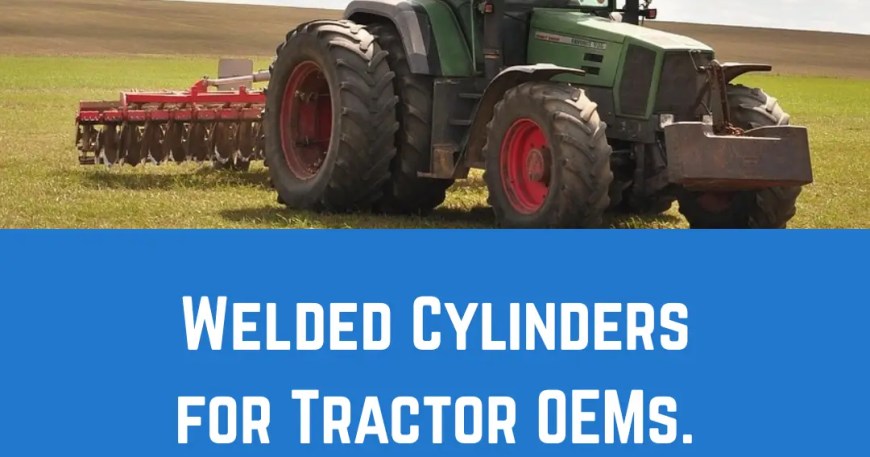
 Modern tractors demand hydraulic cylinders engineered for high loads, harsh agricultural environments, and long duty cycles. Off the shelf or aftermarket cylinders rarely meet the structural, contamination, and lifecycle requirements expected by major OEM manufacturers. This guide explains the engineering principles behind tractor hydraulic cylinders and outlines how custom welded cylinder design improves performance, durability, and system integration for agricultural equipment platforms.
Hydraulic Cylinders for Tractor OEMs
Why Tractor OEMs Need Purpose Built Welded Hydraulic Cylinders
Agricultural machinery operates under heavy loads, continuous cycling, abrasive environments, and highly variable temperatures. Tractor OEMs require hydraulic cylinders that can withstand high shock loads, resist corrosion, minimize drift, and maintain consistent performance across long operating days.
Welded cylinders provide the structural rigidity, compact packaging, and durability needed for modern tractor systems. Unlike tie rod cylinders, welded designs offer better resistance to contamination, side loading, and vibration, making them ideal for loader systems, steering assemblies, 3 point hitches, and auxiliary implements.
Key Applications for Hydraulic Cylinders in Modern Tractors
Front Loader Lift and Bucket Control
Front loader cylinders experience extreme side loading, repeated shock forces, and abrasive contamination. Welded cylinders provide the structural strength and controlled motion required for stable lifting, leveling, and bucket rollback under heavy loads.
Steering Cylinders for Agricultural Terrain
Tractor steering cylinders must handle constant oscillation, uneven ground forces, and high impact loads. OEMs rely on welded double acting cylinders to maintain steering precision and durability across demanding field conditions.
Three Point Hitch Lift Cylinders
The three point hitch requires stable lifting force, controlled descent, and consistent performance with mounted implements. Custom welded cylinders are engineered for long stroke stability, minimized drift, and smooth load transitions.
Auxiliary and Implement Cylinders
Implements such as plows, seeders, balers, sprayers, and tillage tools depend on cylinders that can endure dust, mud, fertilizer exposure, and continuous cycling. Configurations are customized to match attachment geometry and required load cases.
Engineering Requirements for Tractor Hydraulic Cylinders
Welded Cylinder Strength and Structural Reliability
Welded cylinder construction provides better fatigue resistance and overall strength. This allows OEMs to specify cylinders that withstand higher pressures, aggressive duty cycles, and repeated shock loads without structural distortion.
Bore, Stroke, and Pressure Requirements for Agricultural Loads
Agricultural equipment places high demands on lifting, steering, and actuation systems. Proper bore and stroke sizing ensures predictable load handling and improved control. Pressure specifications must account for cold start conditions, soil resistance, and implement variability.
Side Load Handling for Loader and Attachment Systems
Side loading is one of the leading causes of premature cylinder wear in agricultural machinery. Welded cylinders allow optimized bearing lengths, wear band selection, and rod sizing to prevent friction buildup and rod bending under off center loads.
Seal Technology for Dirt, Fertilizer, and UV Exposure
Agriculture exposes cylinders to dust, grit, mud, crop residue, chemicals, and ultraviolet radiation. Seal materials must resist abrasion and compression set while maintaining low friction. Advanced wiper designs improve contamination control and reduce maintenance frequency.
Corrosion Resistance for Agricultural Chemicals
Fertilizer and chemical exposure accelerates rod pitting and barrel corrosion. OEMs often specify nitride or nickel chrome rod coatings and protective barrel finishes to extend cylinder lifespan and reduce warranty claims.
Material and Surface Protection Options for Agricultural Conditions
Rod Coatings for Abrasion and Corrosion
Available options include:
- Hard chrome
- Induction hardened chrome
- Nitride
- Nickel chrome
These coatings improve wear resistance and minimize corrosion in fertilizer rich environments.
Barrel and Component Protection
Barrels may require enhanced paint systems, powder coating, zinc rich primers, or specialty corrosion resistant finishes based on expected exposure.
Wipers and Contamination Control
Low friction wipers prevent soil, dust, and debris from entering the cylinder and damaging internal components. OEMs often select heavy duty wipers for tractors operating in abrasive field conditions.
Custom Cylinder Advantages for Tractor OEMs
Custom welded cylinders enable:
- Optimized load handling for specific tractor models
- Precise geometry matching for loader arms, steering links, and hitch systems
- Reduced hydraulic drift and improved motion control
- Extended service intervals
- Lower long term maintenance costs
These benefits directly support OEM goals related to reliability, equipment performance, and operator productivity.
Validation and Testing Requirements for Tractor Hydraulic Cylinders
Pressure and Cycle Testing
Agricultural duty cycles involve frequent direction changes, high loads, and long operating days. Fully cycled testing ensures the cylinder achieves required service life.
Environmental Contamination Testing
Dust, sand, and agricultural residue require aggressive contamination testing to validate wiper, seal, and coating performance.
Corrosion Testing
Salt spray and chemical exposure tests verify long term resistance to fertilizer, herbicides, and moisture.
Cold Start Performance
Cylinders must perform reliably during cold mornings when hydraulic fluid viscosity increases and system pressures spike.
How Pneu-Hyd Supports Tractor and Agricultural OEM Engineering Teams
Pneu-Hyd collaborates directly with OEM engineering groups to design, test, and manufacture welded hydraulic cylinders tailored to agricultural performance requirements. Support includes:
- CAD modeling and engineering reviews
- Prototype development and refinement
- Custom seal and material recommendations
- Structural and tolerance optimization
- Cold weather and contamination performance analysis
- Scalable production capabilities for OEM programs
Our welded cylinders are engineered for long service life, consistent motion control, and reliable performance in the demanding environments tractors face daily.
Request an Engineering Consultation
If you are designing new tractor platforms, upgrading existing hydraulic systems, or looking to improve durability and performance for your agricultural equipment line, our engineering team is available to assist. Contact us to schedule a consultation or request a custom welded cylinder design review.

1 Comment
Why OEMs Choose Custom Hydraulic Cylinders for Advanced Equipment Design – Pneu-Hyd Industries
December 9, 2025[…] like tractors must withstand high moisture exposure, side loading, and rugged […]